
 +
+

To integrate Juniper SRX Monitoring with MetricFire, please sign up for a free 14 day trial. We want to fully understand your requirements and monitoring goals, so we can advise you on how to obtain better visibility into your infrastructure. Please book a demo with us so we can show you how quick and easy it is to get meaningful data into your MetricFire account, and use that data to build custom dashboards and alerts.
Want fast visibility into SRX performance and interfaces? The quickest path is Telegraf + SNMP sending metrics to your Hosted Graphite account—so you can ship data once and get dashboards and alerts immediately. Follow our SRX walkthrough below or jump straight to the step-by-step Telegraf guide.
MetricFire is a cloud monitoring platform that offers comprehensive monitoring and alerting services for various IT infrastructure components, including Juniper SRX firewalls. The integration enables network administrators to monitor their firewall's health, performance, and security in real-time, as well as receive alerts and notifications when critical events occur.
To integrate Juniper SRX with MetricFire, you can follow these simple steps:
Create an account on MetricFire's platform: To get started, sign up for an account on MetricFire's website. Once you have created your account, you will have access to the MetricFire dashboard, which is where you can set up your Juniper SRX integration.
Configure Juniper SRX: To monitor Juniper SRX devices, you need to configure SNMP on the firewall. This involves setting up SNMP communities and defining the parameters that you want to monitor, such as CPU usage, memory usage, interface traffic, and other relevant metrics.
Add Juniper SRX to MetricFire: Once you have configured SNMP on your Juniper SRX device, you can add it to your MetricFire account.
Set up Telegraf + SNMP for SRX
“Telegraf is a lightweight agent that pulls SRX SNMP metrics and forwards them to Hosted Graphite.
Step 1 — Install Telegraf
Step 2 — Configure Graphite output (servers = ["carbon.hostedgraphite.com:2003"], prefix = "<API_KEY>.telegraf")
Step 3 — Enable SNMP input ([[inputs.snmp]] agents = ["udp://<SRX-IP>:161"])
Step 4 — Select fields (IF-MIB counters, sysUpTime, etc.)
Configure MetricFire's monitoring services: After adding Juniper SRX to MetricFire, you can start configuring the monitoring services that you want to use. MetricFire offers a range of services, such as real-time monitoring, log analysis, anomaly detection, and more. You can set up alerts and notifications based on specific thresholds or events, ensuring that you are always aware of critical issues that could impact your network.
telegraf.conf. (Implementation details are in the guide.)ifOperStatus==down or error rate above X).By integrating Juniper SRX with MetricFire, you can gain visibility into your firewall's performance and security, as well as monitor for potential threats and attacks. MetricFire's comprehensive monitoring and alerting services can help you quickly identify and resolve issues, ensuring that your network is always running smoothly and securely.
MetricFire is a full-scale platform that provides infrastructure, system, and application monitoring using a suite of open-source tools. We will aggregate and store your data as time series metrics, which can be used to build custom dashboards and alerts. MetricFire takes away the burden of self-hosting your own monitoring solution, allowing you more time and freedom to work on your most important tasks.
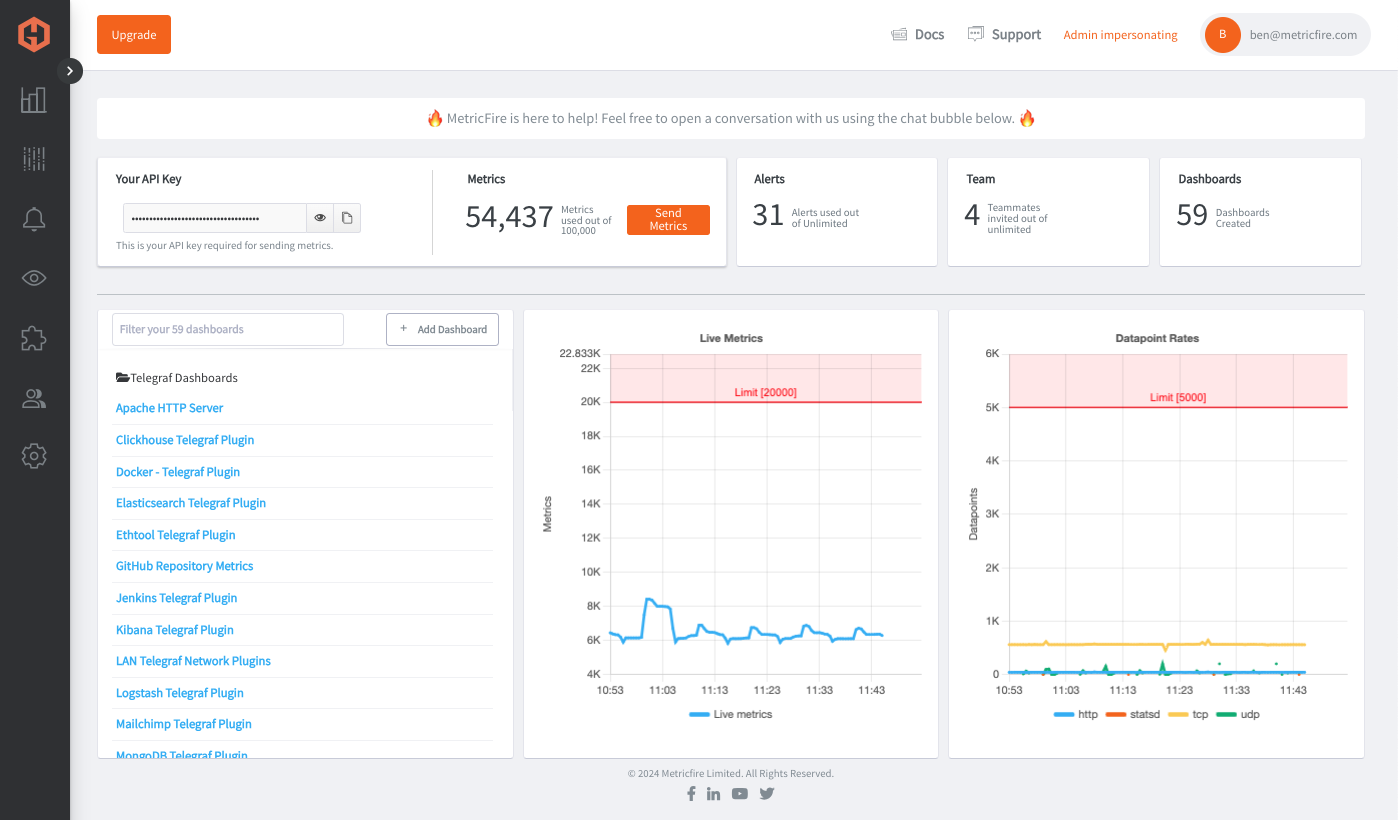
MetricFire offers a complete ecosystem of end-to-end infrastructure monitoring, comprised of open-source Graphite and Grafana. MetricFire handles the aggregation, storage, and backups of your data, and offers alerting, team features, and API's for easy management of your monitoring environment. You can send server metrics using one of our agents, custom metrics from within your application code, and integration metrics from a variety of popular 3rd party services that we integrate with like Heroku, AWS, Azure, GCP, and many more!
Our Hosted Graphite product has improved upon standard Graphite to add data dimensionality, optimized storage, and offers additional tools and features that provide customers with a robust and well-rounded monitoring solution.


“We now have over ten times the amount of metrics we started with, and on different accounts. One of the great things about MetricFire is that scaling to support this increase has been hassle-free, requiring no additional work on our side.”
“Building and managing an on-premise installation at this scale would require a lot of engineer time, especially in the first year...we use this engineering time to work on initiatives closer to our core business”
“There’s complete transparency with everything MetricFire do which means we can accurately predict what we’ll be spending and comfortably keep within our budget.”
"Every time I have a question, I get an answer from support after just a couple of hours. Their technical knowledge is excellent.”

今回は、OpenTelemetryを使ってNGINXのパフォーマンスを監視する方法を解説。NGINXの設定からOpenTelemetry Collectorの導入、Graphiteへのメトリクス送信、Grafanaダッシュボードやアラート作成までをわかりやすくご紹介します。 Continue Reading

Telegrafを使用してNagiosプラグインを監視する方法を解説。Nagios Pluginsの設定、Telegraf execプラグインによるメトリクス収集、Hosted GraphiteとGrafanaを活用したダッシュボード・アラート構築までをステップごとに紹介します。 Continue Reading